
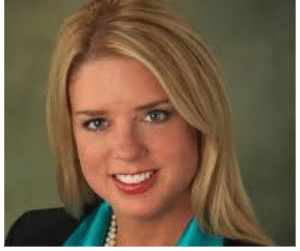
Pam Bondi now sits at the helm of America’s justice system. She is the U.S. Attorney General, sworn in on February 5, 2025.Her journey from a Florida prosecutor to the highest law enforcement office carries both praise and controversy.Early Life & Rise in Law
Early Life & Rise in Law
Pamela Jo Bondi was born on November 17, 1965, in Tampa, Florida.
She earned a Bachelor’s degree in Criminal Justice from the University of Florida in 1987, then a Juris Doctor from Stetson University in 1990.
After law school, she joined the Hillsborough County State Attorney’s Office and spent 18 years prosecuting serious crimes, such as domestic violence and capital murder.
In 2010, Bondi ran for Florida Attorney General and won, becoming the first female to hold that post in the state’s history. She was re-elected in 2014.
During her tenure, she led efforts against “pill mills” — clinics that overprescribed opioids — and she pushed to strengthen anti-trafficking laws.
Transition to National Stage
After her term in Florida ended in 2019, Bondi moved into Washington, D.C. She joined the Ballard Partners lobbying firm, handling corporate and regulatory work.
She also became a key figure at the America First Policy Institute, chairing its litigation arm.
In 2020, Bondi served on Donald Trump’s defense team during his first impeachment trial.
As Trump prepared for a second term, he tapped her to lead the Department of Justice.
The Senate confirmed her on a 54–46 vote.
Agenda & Controversies
pam Bondi pledged to restore integrity to the Justice Department and erase political bias in prosecutions.
On day one, she issued a memo forming a Weaponization Working Group to review prosecutorial abuses.
But critics immediately questioned whether the new mechanisms would themselves be politicized.
She also faces scrutiny for past actions:
-
In 2013, she solicited a $25,000 contribution from Trump while her office weighed joining a lawsuit against him over Trump University.
-
As head of AFPI, she oversaw or supported litigation targeting voting rights and election laws. Some of those suits sought to suppress access to voter registration.
-
During confirmation, she resisted clear answers on potential investigations into Trum pallies and refused to commit to keeping DOJ independent.
In office, Bondi has faced additional flashpoints:
-
She dismissed the DOJ’s ethics adviser without public explanation.
-
She led a purge of career prosecutors who handled Jan. 6-related cases, a move that raised alarms about thinning institutional memory.
-
She recently sparked backlash for hinting that the DOJ might prosecute “hate speech” tied to the killing of conservative activist Charlie Kirk. Many legal experts argued this could chill free speech.
What to Watch
Bondi’s tenure will likely define how politics and justice intertwine in the U.S. Her early moves suggest she intends to reshape DOJ priorities.
Key questions loom:
-
Will the Weaponization Working Group truly act impartially?
-
How far will she go in pursuing investigations of Trump critics?
-
Can she maintain institutional credibility while being a fierce partisan?
In the coming months, Bondi’s strategies and decisions may reshape the balance between political allegiance and legal independence. She occupies a powerful office; how she wields that power will matter for democracy, rule of law, and the public’s trust.